
An importer has just finished unloading a container. A nearby exporter needs an empty one.
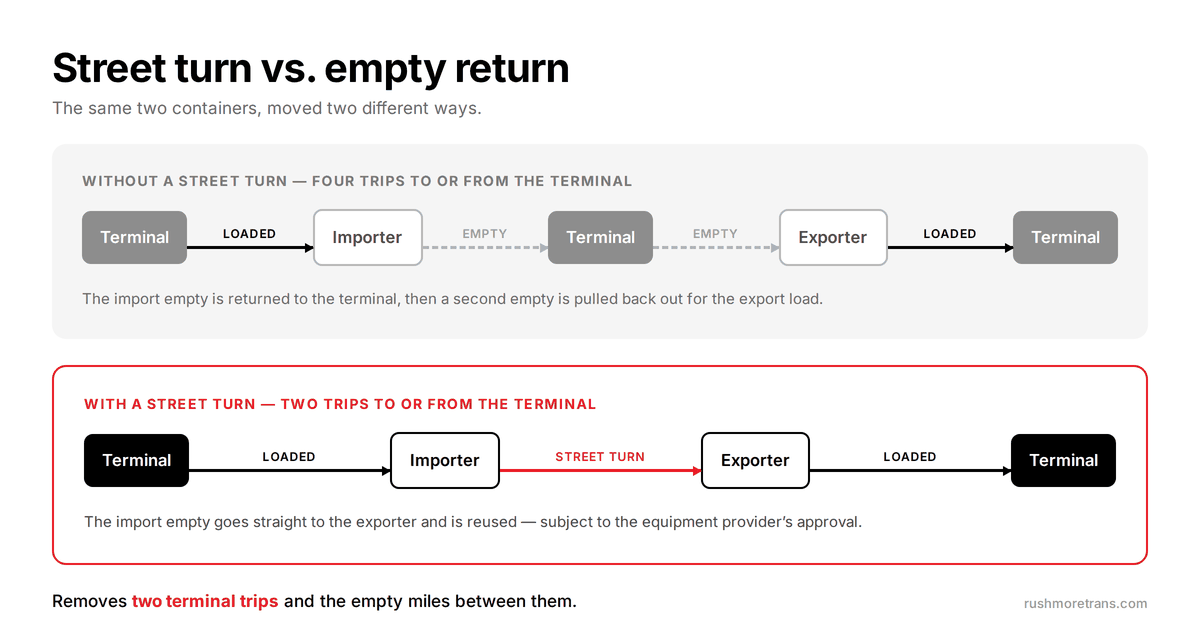
The obvious solution is to move that container from the importer to the exporter. The traditional alternative is to return it to a terminal or depot, then send a truck to collect another empty container—possibly one remarkably similar to the box that just came through the gate.
Logistics occasionally takes the scenic route.
A street turn can eliminate that unnecessary detour. It connects the end of an import delivery with the beginning of an export shipment, allowing the same container to work again without first returning empty to a terminal.
The idea is simple. Making it work requires more than two nearby addresses and an available truck.
What Is a Street Turn in Container Shipping?
A street turn is the authorized reuse of an emptied import container for an export shipment without first returning it to a terminal or container depot. Hapag-Lloyd describes the concept as directly reusing import equipment for export while skipping the intermediate empty drop-off and pickup. Hapag-Lloyd’s container reuse overview
In a conventional arrangement, the import and export moves are handled separately:
- An import container is delivered, unloaded, and returned empty.
- An empty container is collected for an export booking, delivered for loading, and returned loaded.
With a street turn, the emptied import container goes to the export loading location instead. After loading, it moves to the designated export terminal or rail ramp.
The import and export cargo do not have to belong to the same business. What matters is that the equipment, booking, locations, timing, and permissions fit.
The container gets another assignment. It does not become available for anyone to use simply because it is empty.
How a Street Turn Works
A successful street turn has two connected parts: the physical move and the authorization that makes the move legitimate.
1. Identify a container that will become empty
The starting point is an import container with a reasonably reliable unloading schedule.
Dispatch needs to know where it will be, when unloading should finish, and whether the equipment is a potential match for an export load.
“Should be empty sometime Thursday” can identify an opportunity. It is not enough to promise an exporter a Thursday morning loading appointment.
2. Match it to an export booking
The export shipment needs the right container size and type, acceptable equipment condition, and a workable loading schedule.
A 40-foot high-cube dry container does not fill a booking for a 20-foot container. Nor does an empty dry container solve a refrigerated shipment’s equipment needs, however conveniently it happens to be parked.
The ocean carrier controlling the equipment must also accept its use against the export booking. A matching size or familiar logo does not establish that permission.
3. Obtain approval before reuse
Follow the carrier’s current procedure for the location and shipment.
For example, Avantida’s reuse process collects the shipping company, container number, export booking, locations, and reuse date. The request remains pending until the shipping company approves or declines it. Applicable terms and the request price are presented during that process. Avantida’s container reuse instructions
A submitted request is not an approval. Neither is an exporter saying, “We’re fine with it.”
Keep the authorization and confirm any conditions attached to it before proceeding.
4. Inspect the empty container and confirm the handoff
Once the import cargo is unloaded, check whether the container is suitable for the next shipment.
As a practical inspection, look for damage, water intrusion, odors, residue, debris, and problems with the floor or doors. Apply the export shipper’s requirements and the carrier’s instructions; food products or other sensitive cargo may need a more demanding assessment.
Document the container’s condition and any transfer between trucking companies. Establish who has custody and responsibility at each stage.
A container can be the right size and still be the wrong box.
5. Load it and complete the export move
The container moves to the exporter, is loaded, and travels to the designated receiving facility.
The export booking, container number, seal information, and required shipment records must agree. For a rail move, confirm the necessary rail billing and acceptance arrangements before dispatch.
Street-turn approval authorizes reuse. It does not replace the export shipment’s other requirements or guarantee that a terminal will accept the load outside its receiving window.
A Hypothetical Chicago-Area Example
Suppose an importer finishes unloading a suitable container in Elk Grove Village. An exporter in Bensenville needs that equipment type later the same day, and the controlling ocean carrier approves the reuse.
For illustration, assume these road distances:
| Empty-container movement | Conventional arrangement | Street turn |
|---|---|---|
| Import receiver to designated empty-return depot | 35 miles | — |
| Empty-pickup depot to export shipper | 30 miles | — |
| Import receiver directly to export shipper | — | 10 miles |
| Total empty-container miles | 65 miles | 10 miles |
These are hypothetical distances, not measurements for particular facilities. The comparison excludes the loaded import and export legs, assumes no additional repositioning, and does not estimate terminal waiting time.
The street turn removes 55 empty-container miles from this example. It also avoids the intermediate empty return and pickup transactions.
That can mean less driving, less fuel consumption, and fewer opportunities to spend an afternoon waiting at a gate. The actual benefit depends on the full route, equipment arrangements, and schedule.
For Rushmore Transportation LTD’s Chicago-area drayage and intermodal customers, this is a useful planning question: could an import delivery connect with an upcoming export load?
Sharing both schedules gives Rushmore’s dispatch team more information to evaluate than treating each shipment as an isolated move.
Why Street Turns Can Be Worth the Coordination
They reduce unnecessary empty movement
Empty containers still require trucks, drivers, fuel, and road space.
A well-matched street turn shortens the movement between one cargo assignment and the next. Hapag-Lloyd identifies reduced fuel consumption and transport and handling costs among the potential benefits of its container optimization solutions. Hapag-Lloyd’s overview
There is no universal savings percentage. A nearby match may be valuable; a distant one may offer little advantage.
They can make export equipment easier to plan
An approved container with a confirmed unloading time can give an exporter a specific equipment plan.
That benefit depends on the import delivery finishing as expected. If unloading slips, the export loading appointment may slip with it.
Street turns connect two shipments—and, unless carefully managed, can connect their delays too.
They can improve truck utilization
Avoiding an empty return and another pickup may free up driver and truck time for productive work.
But miles are only part of the calculation. A short direct move followed by six hours waiting for export cargo may perform worse than a longer route with dependable appointments.
Good dispatch compares the entire working day.
Who Gets the Savings—and What Does a Street Turn Cost?
There is no standard street-turn price that applies to every carrier, lane, and shipment.
Potential costs include:
- Carrier or platform reuse charges.
- Trucking between the import receiver and export shipper.
- Waiting time at either location.
- Additional chassis days or chassis changes.
- Storage if loading cannot happen promptly.
- Cleaning, inspection, or necessary handling.
- Equipment detention under the applicable terms.
Compare the total cost of completing both shipments with and without reuse.
Also agree on how the benefit appears commercially. Fewer operating miles do not automatically produce identical discounts for the importer and exporter. Rates depend on the work performed, the parties’ agreements, and who carries the added coordination or delay risk.
A useful quote makes those assumptions visible.
Does a Street Turn Reset Container Free Time?
Do not assume that it does.
Container detention generally concerns equipment retained outside a terminal beyond its agreed allowance. Some carrier arrangements combine detention and demurrage, and the applicable contract determines how those periods operate. Maersk’s detention and demurrage terms
Because a street turn skips the normal empty return, confirm how the carrier will record the end of the import equipment use and the start of the export assignment.
Ask:
- What event or approved date closes the import use?
- When does the export equipment allowance begin?
- What charges have already accrued?
- Who pays if the exporter postpones loading?
- What happens if the export booking changes or is canceled?
The approval and applicable carrier terms need to answer those questions. Changing the cargo inside the container is not, by itself, evidence that a billing clock has reset.
The Chassis Needs Its Own Plan
A container and a chassis are separate pieces of equipment.
The chassis is the wheeled frame that carries the container on the road. Permission to reuse the container does not automatically settle chassis use, return obligations, or charges.
Confirm whether the chassis can remain with the container through the export move, whether a change is required, and whether the planned load and route are suitable for the equipment.
Rushmore operates company tractors and chassis, making equipment planning a relevant part of its drayage service. For any proposed street turn, the actual assignment still needs to fit the shipment’s weight, schedule, and receiving requirements.
An efficient container plan can lose its advantage if the chassis must make a separate, unplanned trip.
Can Two Different Trucking Companies Handle a Street Turn?
Yes, where the controlling carrier permits the arrangement and the necessary handoff is properly documented.
Avantida’s shared-reuse process, for example, requires the participating companies to agree to collaborate before the request goes to the ocean line for approval. Agreement between the trucking companies and ocean-carrier authorization are separate steps. Avantida’s shared-reuse process
For such a move, establish the handoff location and time, equipment condition, custody, applicable interchange requirements, and responsibility for charges.
A text saying “driver has the box” is useful operational information. It is a poor substitute for a clear transfer record.
When a Street Turn Does Not Make Sense
Some matches look better on a map than they do on a dispatch board.
Reconsider the arrangement when:
- The schedules are too uncertain. Import unloading may finish after the exporter needs the container.
- The equipment is unsuitable. Size, type, condition, or cargo requirements do not match.
- Approval is unavailable. A potential match remains only a possibility until authorized.
- The export receiving window is too far away. Waiting may add storage and equipment costs.
- The direct route provides little benefit. Additional repositioning can consume the mileage savings.
- The fallback is weak. If reuse fails, there may be too little time to return the import empty or source another export container.
Decide in advance when to abandon the match and use the conventional plan. That decision point protects both shipments from an opportunity that has stopped being useful.
Street Turn, Pre-Pull, and Dual Transaction: Different Tools
These terms describe different ways to organize container moves:
| Term | What it means | Main purpose |
|---|---|---|
| Street turn | Reuse an emptied container for another shipment without first returning it empty to a terminal or depot | Reduce unnecessary empty movement |
| Pre-pull | Collect a container ahead of delivery and stage it temporarily | Separate terminal pickup timing from delivery timing |
| Dual transaction | Complete a container drop-off and pickup during one terminal visit | Combine work into one visit |
A street turn reuses the same container outside the terminal. A dual transaction typically exchanges one container for another at the terminal. A pre-pull addresses a timing gap and does not necessarily involve reuse at all.
Choosing the right tool starts with identifying the problem: an empty-equipment detour,
Related Guides
- What Is a Pre-Pull? When an Extra Container Move Makes Financial Sense
- Drayage Accessorial Charges: A Line-by-Line Guide
- Merchant Haulage vs. Carrier Haulage: Who Arranges the Truck?
- Domestic 53-Foot Containers vs. International Ocean Containers: What Changes Besides the Size?
Need a container moved?
Topics
Recent articles
- Chicago Drayage Rates: What Information Is Needed for an Accurate Quote? September 26, 2026
- Drayage Accessorial Charges: A Line-by-Line Guide September 18, 2026
- How Much Does Drayage Cost? An Itemized Quote Explained September 18, 2026
- Drayage Distance: Why Short Haul Does Not Mean Simple September 17, 2026
- What Is an Intermodal Marketing Company? The Company Connecting Rail, Trucks, and Your Delivery September 16, 2026