
Imagine receiving two quotes for the same container delivery.
One says “$500 base rate.” The other says “$740, including fuel, two chassis days, and tolls.”
The first looks cheaper. It might also become exactly the same price once the missing items are added.
That is the challenge with drayage pricing: the first number does not always describe the complete service.
Drayage cost depends on the transportation being performed, the equipment required, the time involved, and any additional services or third-party charges. A useful quote identifies those items and explains what could change the total.
This guide breaks down an illustrative quote, explains common charges, and shows how to compare providers on the same basis.
What Goes Into a Drayage Price?
A container move can involve three broad categories of cost:
- Planned transportation and equipment: The truck move, fuel surcharge, chassis usage, and other known items.
- Additional services: Waiting, pre-pulls, storage, extra stops, or changes to the delivery arrangement.
- Third-party charges: Applicable terminal, railroad, ocean-carrier, or equipment-provider charges.
Some providers bundle several items. Others list them separately.
Either approach can work if the scope and exclusions are clear.
A flat price with poorly defined exclusions can be harder to budget than an itemized price with straightforward conditions. “All-in” works best when “all” has a written definition.
An Itemized Drayage Quote Example
The following example uses invented amounts in U.S. dollars to explain the calculation. These are not Rushmore Transportation LTD rates, market averages, or a live quotation.
Assume one standard dry-container pickup, delivery for a live unload, and empty return to the agreed location. The example allows two billable chassis days and two hours at the receiver.
| Quote item | Calculation | Amount |
|---|---|---|
| Base transportation | Pickup, delivery, and agreed empty return | $500 |
| Fuel surcharge | 25% of the $500 base rate | $125 |
| Chassis usage | 2 billable days × $45 | $90 |
| Tolls | Fixed amount for the agreed route | $25 |
| Planned total | $500 + $125 + $90 + $25 | $740 |
This planned total assumes no additional waiting charges, pre-pull, yard storage, special equipment, or third-party charges. Actual quotes should state the applicable terminal waiting terms and other conditions.
The calculation is simple. Understanding the assumptions takes a little more attention.
The Main Quote Items Explained
Base Transportation or Linehaul
The base rate covers the transportation described in the quote.
For an import container, that might include terminal pickup, delivery to the receiver, and return of the empty. Confirm all three rather than assuming they are included.
Check the exact locations, container type, weight, and delivery method. A live unload and a drop with later collection involve different operating arrangements.
Also ask what happens if the authorized empty-return location changes. A quote based on one return point may need adjustment if the required movement changes.
Fuel Surcharge
The fuel surcharge, often abbreviated FSC, is a separate fuel-related pricing component when it is not already included.
Providers may calculate it using a percentage, a mileage-based method, or another agreed formula.
In the sample quote, the surcharge applies only to the $500 base transportation charge:
$500 × 25% = $125.
Ask which charges the surcharge applies to, when the percentage is established, and whether it can change before the shipment moves.
A percentage has little meaning without knowing what it multiplies.
Chassis Usage
The chassis is the trailer frame used to transport the container by road.
A chassis charge may depend on billable days, a minimum rental period, or another agreed arrangement. Two days in a quote may be an estimate rather than a fixed maximum.
Confirm:
- When billing starts and stops.
- Whether days are calendar days or another billing unit.
- Whether weekends and partial days count.
- Whether a minimum applies.
- How extra days are charged.
Chassis usage and ocean-container detention are separate concepts. Paying for one does not necessarily include the other.
Tolls and Route-Related Charges
Tolls may be included, quoted separately, or billed according to actual usage.
Check whether the amount is fixed for the agreed route or an estimate. Additional stops, route restrictions, and changed pickup or return locations can affect the transportation required.
For Chicago-area shipments, provide the exact ramp and receiving address. “Chicago to Chicago” leaves considerable room for interpretation.
Accessorial Charges: What Can Be Added?
An accessorial is a charge for an additional service or operating condition. The quote should identify the trigger, rate, billing unit, and any approval requirements.
Common drayage accessorials include:
Driver waiting or detention: Time beyond the included allowance at a terminal or receiving facility. Confirm whether each location has a separate allowance and how time is documented.
Pre-pull: Collecting a container before its delivery date and holding it temporarily. Ask whether the quoted fee includes storage, equipment time, and subsequent delivery.
Yard storage: Holding a loaded or empty container at an agreed location. Check whether handling or lift charges are separate.
Chassis split: An additional movement to collect or return a chassis at a location separate from the container.
Drop and later collection: Leaving the container at the receiver and returning for it after unloading. Equipment usage may continue between visits.
Dry run: A failed pickup or delivery attempt. Review the cause, agreed terms, and supporting records before determining the applicable charge.
Special equipment or handling: Services such as a tri-axle chassis, scaling, refrigeration support, or hazardous-material handling where required.
A heavy-container accessorial does not itself provide legal authority to move an overweight shipment. Equipment selection and permit requirements still need to be addressed.
Driver Detention and Container Detention Are Different
The word “detention” can describe two different charges.
Driver detention concerns waiting time for the truck and driver, usually measured in hours or smaller increments under the trucking agreement.
Container detention concerns extended use of the container under the ocean carrier’s or equipment provider’s terms, commonly after applicable free time expires.
Per diem is another term used for daily equipment-use charges. The invoice and governing terms should identify the equipment and billing period.
A truck waiting at a warehouse and a container remaining outside the terminal are different events, even when they overlap.
When an invoice says only “detention,” ask what was detained, for how long, and under which terms.
Demurrage, Rail Storage, and Other Third-Party Charges
Demurrage generally concerns a container remaining at a marine terminal beyond applicable free time.
Rail storage concerns equipment remaining at a rail facility under the railroad’s rules. Depending on the shipment, ocean-carrier equipment charges may also apply separately.
These amounts may appear on separate invoices. A drayage provider might also advance an authorized payment and rebill it.
If that happens, ask for:
- The original charge and issuing provider.
- The container number and dates.
- Supporting invoices or receipts.
- Any separately agreed advancement or administration fee.
Do not assume an ordinary trucking quote includes ocean freight, customs duties, brokerage, examinations, terminal handling, or accumulated storage.
Likewise, identify anything already paid or included elsewhere so the same service is not charged twice.
How a $740 Plan Could Become $1,210
Return to the illustrative quote.
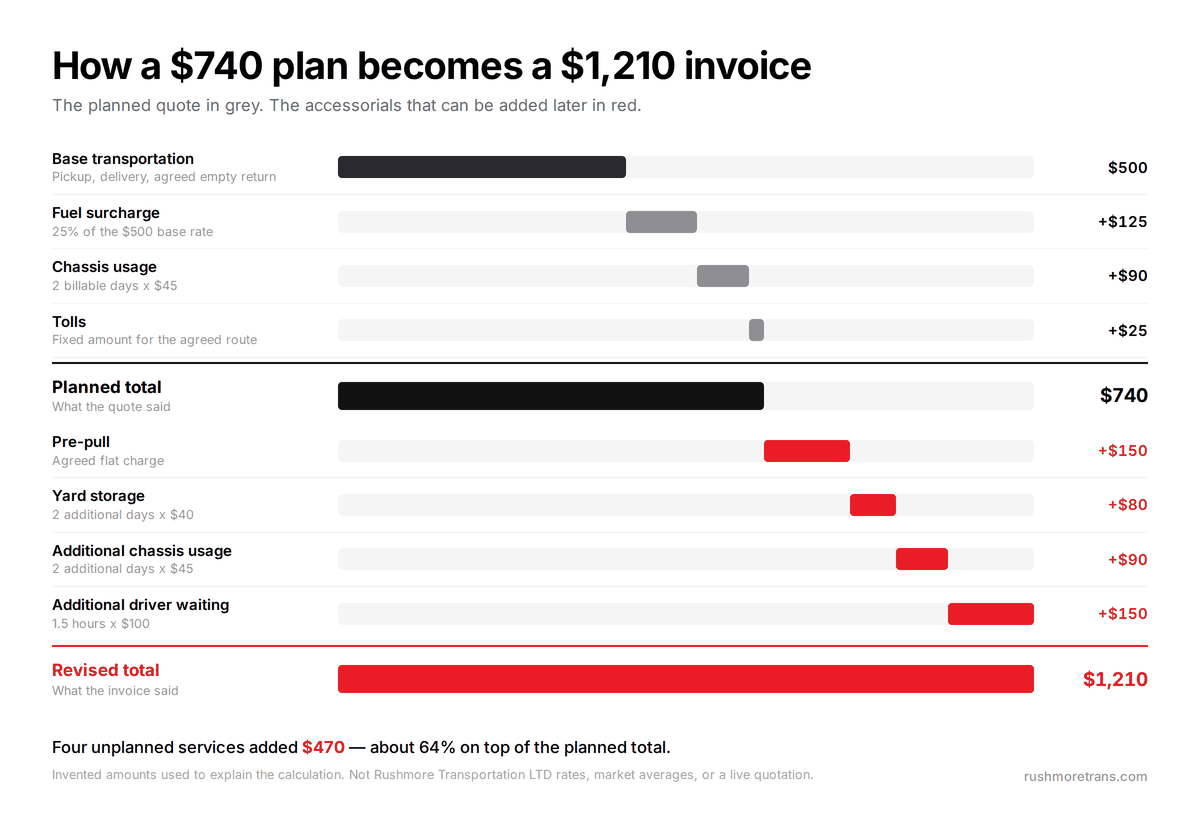
Suppose the receiver postpones delivery. The customer approves a pre-pull and two additional days of yard storage. The chassis remains in use for those two extra days. At delivery, the receiver also uses 1.5 hours beyond the included waiting allowance.
Using additional invented rates:
| Additional service | Calculation | Added cost |
|---|---|---|
| Pre-pull | Agreed flat charge | $150 |
| Yard storage | 2 additional days × $40 | $80 |
| Additional chassis usage | 2 additional days × $45 | $90 |
| Additional driver waiting | 1.5 hours × $100 | $150 |
| Additional charges | $470 | |
| Revised total | $740 + $470 | $1,210 |
This example assumes the listed additional rates require no further fuel surcharge and no other charges arise.
The loaded delivery distance has not changed. The services and equipment time have.
That is why a useful quote explains both the expected total and the conditions that could change it.
How to Compare Two Drayage Quotes
Give each provider the same shipment information and compare the same service.
Check these points:
- Transportation scope: Are pickup, delivery, and empty return included?
- Fuel: Is it included, and what formula applies?
- Equipment: Which chassis type and how many billable days are assumed?
- Waiting: What time is included at each facility, and how are additional increments billed?
- Delivery method: Is the price for a live unload or a drop with later collection?
- Additional services: What are the rates for likely exceptions?
- Validity: How long does the quote remain valid, and which changes require repricing?
- Third-party costs: What remains outside the transportation quote?
A lower base rate can still produce the lower total. It simply needs to be compared with the same assumptions.
How to Reduce Invoice Surprises
Provide complete shipment details before booking, including cargo weight, equipment needs, the exact pickup terminal, receiving requirements, and known deadlines.
Confirm pickup readiness before dispatch. Match the warehouse appointment to realistic container availability.
Name the person authorized to approve changes and agree on when the carrier should contact them. For a dropped container, report empty readiness promptly through the required process.
Finally, retain the records that explain the move: gate receipts, arrival and departure times, proof of delivery, empty-return confirmation, and written approvals.
Those records help resolve a billing question while everyone still remembers what happened.
Common Questions About Drayage Costs
Is Drayage Charged Per Mile or Per Container?
Providers may quote a flat rate per container movement, use mileage or time calculations, or combine several methods. Ask what the quoted price covers and which charges remain variable.
Does an All-In Quote Include Demurrage and Detention?
Only if those items are expressly included under defined conditions. Many transportation quotes exclude terminal storage, ocean-container detention, and waiting beyond stated allowances.
Is Two Hours of Free Waiting Standard?
Do not assume it is. Included time, starting events, billing increments, and treatment of late arrivals vary by agreement. The two-hour allowance in this article is part of the hypothetical example.
Can a Pre-Pull Save Money?
It can help avoid terminal charges or protect a delivery plan, but it can also add trucking, storage, and equipment costs. Compare the complete alternatives before approving it.
What Do I Need for an Accurate Drayage Quote?
Provide the pickup terminal, delivery address, container size and type, cargo weight, expected availability, receiving appointment, unloading method, and known empty-return instructions.
Request an Itemized Quote From Rushmore
Rushmore Transportation LTD provides container drayage throughout Chicagoland and the Midwest.
Send your shipment details and receiving requirements to request a quote based on the complete move. Include any need for a pre-pull, drop service, specialized chassis, or temporary storage.
Ask for the planned total, its assumptions, and the rates for additional services so you can budget before the container moves.
Related Guides
- Drayage Accessorial Charges: A Line-by-Line Guide
- Drayage Distance: Why Short Haul Does Not Mean Simple
- Overweight Container Drayage in Illinois, Indiana, Wisconsin and Iowa
- What Is a Street Turn? How Container Reuse Cuts Empty Miles
Need a container moved?
Topics
Recent articles
- Chicago Drayage Rates: What Information Is Needed for an Accurate Quote? September 26, 2026
- Drayage Accessorial Charges: A Line-by-Line Guide September 18, 2026
- How Much Does Drayage Cost? An Itemized Quote Explained September 18, 2026
- Drayage Distance: Why Short Haul Does Not Mean Simple September 17, 2026
- What Is an Intermodal Marketing Company? The Company Connecting Rail, Trucks, and Your Delivery September 16, 2026