
If you ship containers through Chicago, the ramp your box lands at decides a lot: how far the dray is, how fast the gate moves, how much free time you get, and how easy it is to find a chassis. Chicago is the largest rail hub in North America, and as of September 2026 there are fifteen active intermodal terminals spread across six railroads and roughly fifty miles of the metro area. This guide lists every one of them, what each ramp mostly handles, and the approximate driving distance from our yard on Franklin Avenue in Franklin Park.
Chicago rail ramps at a glance
| Railroad | Ramp | Location | Mostly handles | From Franklin Park |
|---|---|---|---|---|
| CPKC | Bensenville | 10800 Franklin Ave, Franklin Park | International (Vancouver, Montreal), domestic, Mexico | Under 1 mile |
| UP | Global II | Northlake | Domestic | ~2 miles |
| BNSF | Cicero | 5601 W 26th St, Cicero | Domestic | ~10 miles |
| BNSF | Willow Springs | 7600 Santa Fe Dr, Hodgkins | Domestic, parcel and trailer traffic | ~14 miles |
| BNSF | Corwith | 3526 W 43rd St, Chicago | International and domestic | ~15 miles |
| CSX | Bedford Park | 7000 W 71st St, Bedford Park | East Coast international and domestic | ~15 miles |
| CSX | 59th Street | 2101 W 59th St, Chicago | East Coast international and domestic | ~18 miles |
| NS | 47th Street | 361 W 47th St, Chicago | Domestic | ~19 miles |
| NS | Landers | 7540 S Western Ave, Chicago | International and domestic | ~20 miles |
| NS | 63rd Street / Englewood | 6300 S Indiana Ave, Chicago | Domestic | ~21 miles |
| UP | Yard Center | Dolton | Auto parts, north–south (Mexico) traffic | ~32 miles |
| CN | Harvey (Gateway) | 16800 S Center Ave, Harvey | International (Prince Rupert, Vancouver, Halifax, Montreal, Gulf), domestic | ~34 miles |
| CN | Joliet | Joliet | Domestic and international | ~40 miles |
| UP | Global IV | 13000 Centerpoint Way, Joliet | International (West Coast) | ~45 miles |
| BNSF | Logistics Park Chicago | 26664 Baseline Rd, Elwood | International (LA/Long Beach) and domestic | ~48 miles |
Distances are approximate driving miles from 11101 Franklin Ave, Franklin Park, IL 60131. What each ramp “mostly handles” reflects how the railroads have organized their Chicago traffic since 2019 and can change; confirm with the railroad or your steamship line for a specific move.
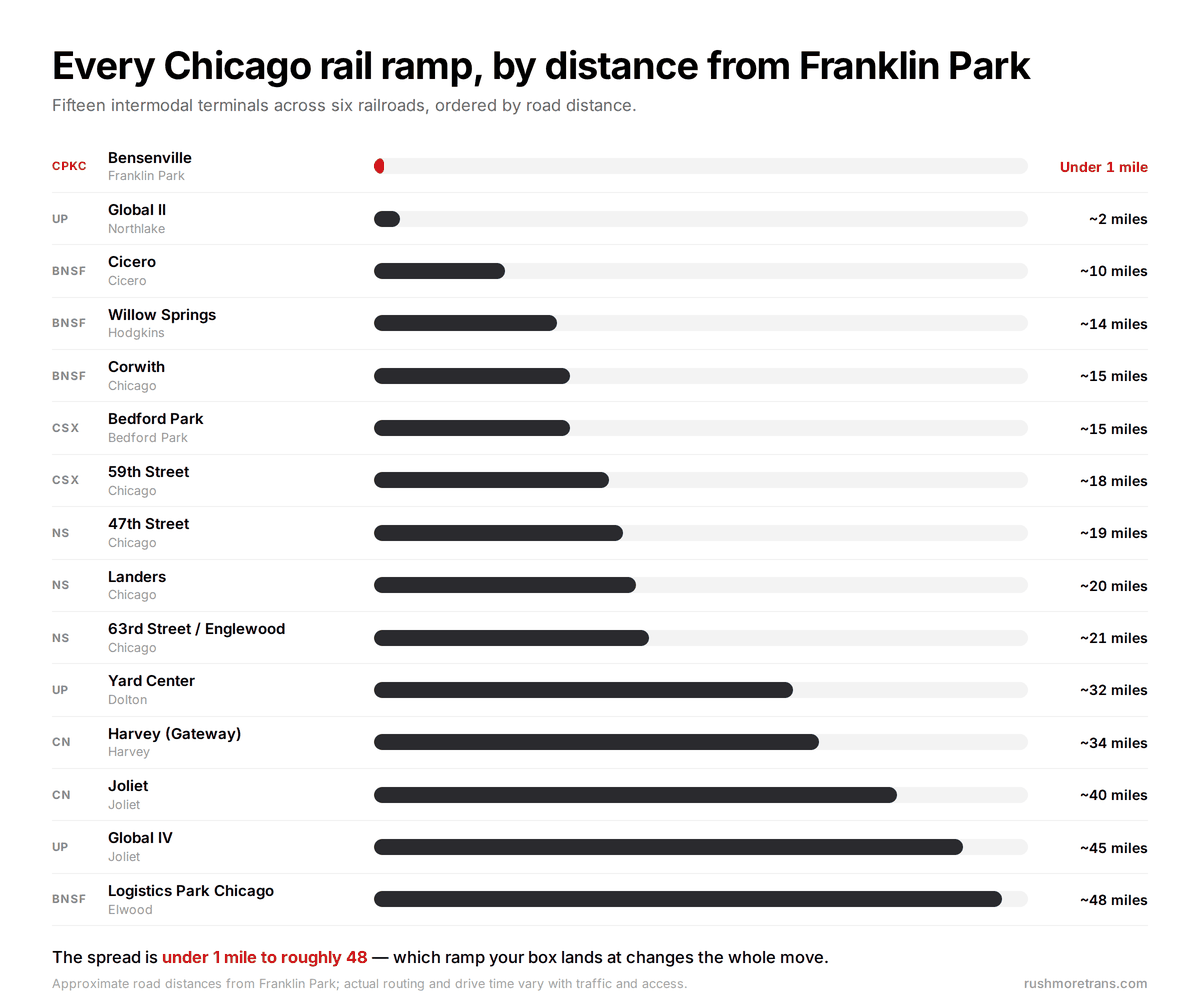
CPKC: Bensenville
The Bensenville terminal sits on Franklin Avenue in Franklin Park, a few hundred yards from our yard. It is the Chicago gateway for containers arriving through the Canadian West Coast and Montreal, and since the Canadian Pacific–Kansas City Southern merger it also connects directly to Mexico. For anything landing at Bensenville, a Rushmore driver is on the ramp within minutes of the container being grounded, which matters when free time is short.
Union Pacific: Global II, Global IV and Yard Center
Union Pacific reorganized its Chicago terminals in 2019. Global I on Western Avenue and Global III in Rochelle were idled, and the remaining ramps were given distinct jobs: Global II in Northlake handles domestic containers, Global IV in Joliet handles international containers arriving from the West Coast, and Yard Center in Dolton handles auto parts and north–south traffic. The practical effect for importers is that West Coast ocean containers on UP now land 45 miles southwest of O’Hare rather than in the city, so the dray to a north or northwest suburban warehouse is a longer, more expensive move than it was before 2019.
BNSF: Logistics Park Chicago, Cicero, Corwith and Willow Springs
Logistics Park Chicago (LPC) in Elwood is BNSF’s flagship Chicago terminal and the busiest international ramp in the region, fed by the ports of Los Angeles and Long Beach. It is also the farthest ramp from the northwest suburbs, and the Elwood/Joliet area around it — home to Global IV and CN Joliet as well — is where Chicago’s worst ramp queues and chassis shortages tend to show up in peak season. Cicero and Willow Springs are domestic ramps, with Willow Springs carrying a lot of parcel and trailer traffic. Corwith, on the Southwest Side, handles a mix of international and domestic loads and is the closest BNSF ramp to the city’s industrial corridors.
CSX: Bedford Park and 59th Street
CSX brings East Coast port traffic — New York/New Jersey, Baltimore, Norfolk, Savannah — into Chicago at Bedford Park and 59th Street, both on the Southwest Side within a few miles of each other. CSX added a container storage yard at 63rd Street to support both terminals. Bedford Park is the larger of the two and the one most East Coast import moves are routed through.
Norfolk Southern: Landers, 47th Street and 63rd Street
Landers, at 79th and Western, is NS’s international ramp in Chicago and the arrival point for containers coming inland from Norfolk, Savannah and the other Atlantic ports NS serves. 47th Street and 63rd Street/Englewood are domestic terminals a few miles north of Landers. All three are in dense South Side neighborhoods where gate queues can back up onto surface streets, so drivers who know the approach routes save real time.
CN: Harvey and Joliet
CN’s Harvey terminal, also called Gateway, is where containers from Prince Rupert, Vancouver, Halifax and Montreal enter Chicago, along with Gulf Coast traffic through Mobile and New Orleans. Prince Rupert in particular has become a popular routing for Asian imports bound for the Midwest because the sailing is shorter and the ramp is less congested than the Southern California-to-Elwood route. CN’s Joliet terminal handles domestic and some international traffic on the south end of the metro.
How the ramp changes your drayage bill
- Distance. Base drayage rates in Chicago are driven mainly by miles between the ramp and the delivery address. A delivery to Elk Grove Village from CPKC Bensenville is a short local move; the same delivery from BNSF Logistics Park is a 60-mile run each way. Our published drayage rates by ZIP code show the base linehaul for thousands of Midwest destinations.
- Free time. Each railroad sets its own free time at the ramp, commonly a couple of days from the time the container is grounded and made available. When the ramp is far from the receiver, or the receiver only takes deliveries on certain days, a pre-pull to our yard is often cheaper than a day of rail storage. Our guide to demurrage, detention and rail storage in Chicago walks through the clocks in detail.
- Chassis. Chassis availability varies by ramp and by pool. Rushmore runs its own fleet of 20/40 and tri-axle chassis, which removes the “no chassis at the ramp” problem entirely and lets us handle overweight containers bound for Illinois, Indiana, Wisconsin and Iowa.
- Gate hours and queues. Terminal gates keep different hours, and some ramps run weekend gates while others do not. Weekend pre-pulls are one of the most effective ways to beat a Monday last free day.
- Empty returns. Where the empty has to go back is set by the steamship line and changes constantly. Returning to the wrong location, or to a ramp that is not accepting that line’s empties that day, costs a second trip. We check return locations daily before dispatching.
Moving containers at every Chicago ramp
Rushmore Transportation is an asset-based carrier headquartered next to the CPKC Bensenville ramp in Franklin Park, with company drivers, company chassis and partner coverage at every ramp on this list. If you have containers landing in Chicago and want a firm price, request a quote or call dispatch at (312) 238-9395.
Related Guides
- Port Drayage vs. Rail Drayage: What Changes for the Shipper?
- How Container Drayage Works: From Arrival Notice to Empty Return
- What Is a Pre-Pull? When an Extra Container Move Makes Financial Sense
- Overweight Container Drayage in Illinois, Indiana, Wisconsin and Iowa
Need a container moved?
Topics
Recent articles
- Chicago Drayage Rates: What Information Is Needed for an Accurate Quote? September 26, 2026
- Drayage Accessorial Charges: A Line-by-Line Guide September 18, 2026
- How Much Does Drayage Cost? An Itemized Quote Explained September 18, 2026
- Drayage Distance: Why Short Haul Does Not Mean Simple September 17, 2026
- What Is an Intermodal Marketing Company? The Company Connecting Rail, Trucks, and Your Delivery September 16, 2026