
A container arrives at a Chicago rail terminal. To someone outside the industry, it looks like a large metal box waiting for a truck.
To a dispatcher, it raises several immediate questions: What size? Which chassis? Is it released? How heavy is it? When can the receiver unload it? And where does the empty go afterward?
The box has barely introduced itself, and already it has a list of demands.
Domestic 53-foot containers and international ocean containers both move freight through intermodal networks. But they serve different purposes—and those differences affect loading, transportation costs, equipment selection, and delivery planning.
The essential distinction: domestic 53-foot containers are built around North American inland transportation, while international ocean containers are built around global shipping networks. Choosing between them means looking beyond length to the entire trip your freight needs to make.
Domestic vs. International Containers: Same Idea, Different Systems
Intermodal transportation means using more than one transportation mode for a shipment. With containerized freight, the container can transfer between a truck and a train—or a vessel, train, and truck—without unloading the goods at each transfer.
Both domestic and international containers participate in this system. “Intermodal” does not mean “domestic,” and “ocean container” does not mean the box spends its entire working life near salt water. Railroads such as BNSF handle both domestic and international intermodal traffic. Source: BNSF intermodal services.
A typical domestic movement might involve a truck taking a loaded 53-foot container from a shipper to a rail terminal, a train carrying it between regions, and another truck completing delivery.
An international shipment might travel in a 40-foot container from an overseas factory to a seaport, cross the ocean, move inland by rail, and reach a warehouse on a chassis.
That final truck movement is drayage: the connection between the terminal and the customer’s facility. It may represent only a small portion of the shipment’s mileage, but it is where terminal availability, equipment, paperwork, and receiving schedules must finally agree.
Rushmore Transportation LTD’s Chicago-area container drayage and intermodal work supports this inland connection, along with the dispatch and customer-service coordination needed to turn an arriving container into a completed delivery.
53-Foot Container vs. 40-Foot High Cube: Dimensions Compared
For ordinary dry freight, the most useful comparison is between a domestic 53-foot container and the common 20-foot, 40-foot, and 40-foot high-cube ocean containers.
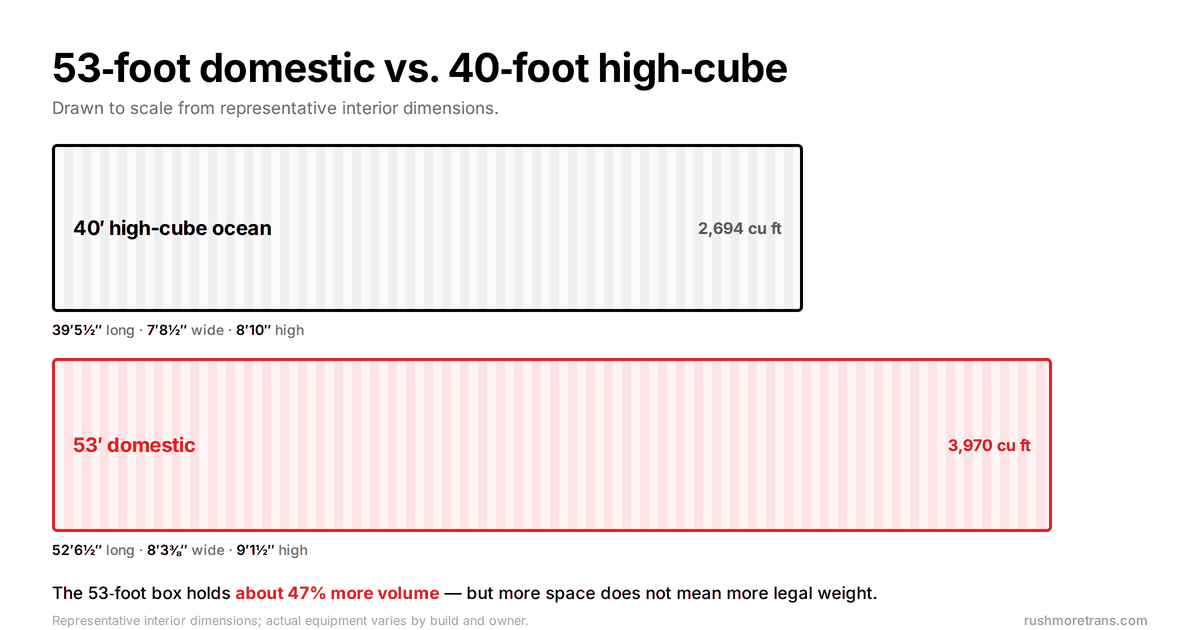
A high cube provides additional height. It does not automatically provide additional legal cargo weight.
| Container type | Representative interior length | Representative interior width | Representative interior height | Approximate internal volume |
|---|---|---|---|---|
| 20-foot standard ocean | 19′4″ | 7′8½″ | 7′10″ | 1,172 cubic feet |
| 40-foot standard ocean | 39′5½″ | 7′8½″ | 7′10″ | 2,390 cubic feet |
| 40-foot high-cube ocean | 39′5½″ | 7′8½″ | 8′10″ | 2,694 cubic feet |
| 53-foot domestic | 52′6½″ | 8′3⅜″ | 9′1½″ | 3,970 cubic feet |
These rounded figures represent specific carrier equipment, not guaranteed dimensions for every container. Confirm the assigned equipment and door opening before loading. Sources: Hapag-Lloyd’s 20-foot standard, 40-foot standard, and 40-foot high-cube specifications; Union Pacific’s EMP and UMAX specifications.
Using those published examples, the 53-footer offers about 47% more internal volume than a 40-foot high cube. That can matter enormously for lightweight, bulky products.
But cubic capacity is only the beginning of a loading plan.
Width can matter as much as length
Two 48-inch-wide pallet loads require 96 inches across before allowing any clearance. That arrangement cannot fit inside an ocean container with roughly 92½ inches of interior width. It may fit inside a domestic container with approximately 99 inches—provided the actual freight, packaging, and loading clearances cooperate.
Rotate those pallets so their 40-inch sides run across the container, and the calculation changes.
This is why a pallet count without dimensions is an invitation to a second conversation, usually after the forklift has arrived.
The door gets the final vote
Interior height and door-opening height are different measurements.
Hapag-Lloyd’s representative 40-foot high cube has roughly 8 feet 10 inches of interior height, but a door opening approximately 8 feet 6¼ inches high. A tall crate can fit inside on paper and still fail to enter. Source: Hapag-Lloyd high-cube specifications.
Check the loaded unit’s dimensions—including pallet, packaging, and any clearance needed for handling.
Container Weight Limits: More Space Does Not Mean More Legal Weight
A larger container is useful when a shipment cubes out—runs out of room before reaching its weight limit.
It is less helpful when a shipment weighs out first.
Furniture and lightweight consumer goods may benefit from additional volume. Dense machinery or bagged materials may reach the allowable weight with plenty of empty space remaining. Paying to move that empty space does not make the load any more legal.
Three separate limits matter:
- The container’s rating: what the equipment is designed to carry.
- The transportation provider’s limit: what the booked service accepts.
- The road limit: what the complete truck combination and its axle groups may legally carry along the route.
For ordinary Interstate operations, the federal baseline is 80,000 pounds gross vehicle weight, 20,000 pounds on a single axle, and 34,000 pounds on a tandem axle group, subject to the Bridge Formula and applicable exceptions. Gross weight includes the tractor, chassis, container, cargo, and other carried weight. State rules, route restrictions, equipment ratings, and any permit eligibility also require review. Source: Federal Highway Administration.
Hypothetical example: If an operating truck, chassis, and empty container together weigh 35,000 pounds, an 80,000-pound gross ceiling leaves 45,000 pounds for cargo. That subtraction alone does not establish a legal load: axle distribution, bridge limits, equipment ratings, and carrier restrictions still apply.
The practical lesson is simple: provide the drayage carrier with accurate cargo weight before dispatch. Discovering the problem at a scale is an expensive way to improve the paperwork.
A 53-Foot Container Is Not a 53-Foot Trailer
They may offer similar freight space, but they are different equipment.
A dry-van trailer has its running gear as part of the trailer. A container is a removable cargo unit. For road travel, it sits on a chassis, the wheeled frame underneath it.
That distinction affects equipment availability, empty weight, and handling. A loading plan suitable for a dry van should not automatically be treated as an approved intermodal loading plan; confirm the provider’s requirements.
Likewise, an ocean-container chassis and a domestic-container chassis are not interchangeable merely because both have wheels. Container length, mounting arrangements, chassis configuration, and equipment-provider rules must match.
For the shipper, “send a truck” needs a little more detail: send a truck with the correct equipment for this container and this load.
Transloading: Should Imported Freight Stay in the Ocean Container?
An importer does not necessarily need a domestic container after the shipment reaches the United States.
There are two common approaches.
Keep the freight in its original container
The ocean container continues inland, potentially by rail, and a drayage carrier delivers it to the receiver.
This can be attractive when the goods are going to one destination and there is no operational reason to unload them earlier. It avoids an additional cargo transfer.
Hypothetical example: A 40-foot container of machinery arrives at a Chicago rail terminal for delivery to one nearby facility. Moving the machinery into a 53-foot container solely to gain unused space could add handling, cost, and damage exposure without improving the shipment.
In this situation, the priorities are release status, weight, equipment, the delivery appointment, and the empty return.
Transload into domestic equipment
Transloading means unloading freight from one transportation unit and loading it into another. Imported goods may transfer from ocean containers into domestic containers or trailers for onward distribution.
This can support consolidation, sorting by destination, or a different inland transportation plan. (For how the ocean booking itself shapes inland delivery, see FCL vs. LCL: How Your Ocean Freight Choice Changes Inland Delivery.)
Hypothetical example: Several ocean containers hold lightweight merchandise destined for the same inland distribution center. Combining that freight into fewer, larger domestic units may reduce onward transportation costs—if the goods fit, the weights work, and the savings exceed the additional handling and local transportation costs.
The comparison should include:
- Transportation to and from the transload facility.
- Unloading, sorting, reloading, and any storage.
- Outbound equipment availability and transportation.
- Cargo-handling risk and delivery timing.
- Ocean-container return costs and deadlines.
There is no universal conversion ratio that guarantees savings. Cartons, pallets, stackability, and weight have an inconvenient habit of refusing to behave like perfect rectangles in a spreadsheet.
Compare the Complete Move, Including the Empty
A transportation quote becomes much more useful when everyone agrees on where the service starts and ends.
For container drayage, delivery is not necessarily the last equipment movement. Once the receiver unloads the freight, the empty container still needs an authorized destination.
That return can affect mileage, driver time, scheduling, and equipment charges.
Other costs may include chassis use, terminal storage, waiting time, or additional moves. Free time is the applicable period before specified charges begin; the allowance and charging rules depend on the provider and agreement.
In ocean shipping, demurrage generally concerns a container remaining at a marine terminal beyond free time, while detention concerns extended equipment use outside the terminal. Rail storage and domestic equipment charges follow their applicable terms; do not assume the same clock or terminology applies everywhere. Source: Federal Maritime Commission’s detention and demurrage guidance.
Ask for the full operating picture:
Pickup, delivery, unloading arrangement, equipment use, and empty return.
A low pickup-and-delivery rate is not much of a bargain if the rest of the move is still waiting to introduce itself.
Chicago Drayage: Where the Plan Meets the Appointment
For a Chicago-area receiver, the ocean voyage or rail journey can feel like the complicated part. Yet the local delivery still depends on several conditions lining up.
Before dispatch, confirm:
- Actual availability: Has the container become available for pickup, rather than simply arrived?
- Release status: Are applicable carrier, terminal, and customs requirements satisfied?
- Equipment and weight: Is the correct chassis available, and can the shipment move legally?
- Receiving arrangements: Is the appointment confirmed, and will the facility unload while the driver waits or accept an approved drop?
- Return instructions: Where and when can the empty equipment be returned?
Rushmore Transportation LTD supports Chicago-area container movements through drayage, dispatch, import/export coordination, documentation, and customer communication. These functions matter because the transportation plan extends beyond assigning a tractor.
A truck cannot fix an unreleased container by arriving enthusiastically.
Sharing complete shipment information early gives the team a better opportunity to identify conflicts before they become missed appointments or unnecessary trips.
Which Container Makes Sense for Your Shipment?
Start with the freight and the route.
| Your shipment needs | What to evaluate |
|---|---|
| International ocean transportation | Equipment accepted by the ocean carrier for the booked service |
| Inland transportation of bulky, relatively light freight | A 53-foot domestic container’s additional usable space |
| Delivery of an intact import load to one receiver | Keeping the freight in its ocean container through delivery |
| Distribution of imported goods across multiple destinations | Transloading, sorting, and the complete onward transportation cost |
| Movement of dense or heavy freight | Legal payload, axle distribution, equipment configuration, and route |
| A tightly scheduled delivery | Actual service availability, terminal pickup conditions, and receiving capacity |
Container size supports the plan. It cannot replace one.
Frequently Asked Questions
What is the difference between a 53-foot domestic container and a 40-foot ocean container?
A 53-foot domestic container is built for North American rail and truck transportation and offers roughly 47% more internal volume than a 40-foot high cube, plus extra interior width. A 40-foot ocean container is built for international shipping and moves on ocean vessels, rail, and chassis worldwide.
Can a 53-foot container be shipped overseas?
Generally, no. 53-foot containers are designed for domestic intermodal service in North America. International ocean shipments typically use 20-foot, 40-foot, or 40-foot high-cube containers accepted by the ocean carrier.
Does a bigger container let me ship more weight?
Not necessarily. Road limits still apply. The federal baseline for ordinary Interstate operations is 80,000 pounds gross vehicle weight, which includes the tractor, chassis, container, and cargo. Dense freight often reaches its weight limit before filling a container.
Is a 53-foot container the same as a 53-foot trailer?
No. A dry-van trailer has its own running gear. A container is a removable box that rides on a separate chassis for road travel, which affects equipment availability, empty weight, and handling.
When does transloading ocean containers into domestic equipment make sense?
Transloading can make sense when imported freight is going to multiple destinations or is light and bulky enough that consolidating into fewer 53-foot units lowers onward costs. The savings must exceed the added handling, transload facility, and container return costs.
Put the Shipment Details on the Table
The useful question is not simply, “Which container is bigger?”
It is: Which equipment and transportation plan will get this freight to the right place, with manageable handling, predictable costs, and a workable delivery schedule?
If you need Chicago-area container drayage or help coordinating an inland container movement, send Rushmore Transportation LTD a message with the pickup terminal, delivery ZIP code, container size, cargo weight, and required delivery date. Include the container or booking number and any availability or free-time information you already have.
Those details turn a general inquiry into a shipment the team can evaluate.
The container may be a steel box. Getting it delivered properly takes a little more thought.
Related Guides
- Drayage vs. Intermodal vs. Truckload: Which Service Do You Need?
- Overweight Container Drayage in Illinois, Indiana, Wisconsin and Iowa
- Live Unload vs. Drop and Pick: Which Fits Your Warehouse?
- What Is an Intermodal Marketing Company? The Company Connecting Rail, Trucks, and Your Delivery
Need a container moved?
Topics
Recent articles
- Chicago Drayage Rates: What Information Is Needed for an Accurate Quote? September 26, 2026
- Drayage Accessorial Charges: A Line-by-Line Guide September 18, 2026
- How Much Does Drayage Cost? An Itemized Quote Explained September 18, 2026
- Drayage Distance: Why Short Haul Does Not Mean Simple September 17, 2026
- What Is an Intermodal Marketing Company? The Company Connecting Rail, Trucks, and Your Delivery September 16, 2026