
“It’s only 20 miles.”
In container drayage, those four words can hide an entire day’s worth of assumptions.
The warehouse looks close to the rail ramp. The container has already traveled thousands of miles. Surely the final stretch should be the easy part.
Then someone checks the release status. The chassis needs attention. The receiving appointment does not match the pickup window. And the empty container needs to return to a different location.
The map has excellent geography and very little experience returning an empty container.
Drayage distance measures the road between locations. The complete job also includes terminal access, equipment handling, delivery coordination, unloading, and equipment return. A short drive can sit inside a much longer operation.
Understanding that difference helps shippers compare quotes, schedule deliveries, and prevent avoidable charges.
What Does Drayage Distance Actually Measure?
When someone describes a shipment as a “20-mile dray,” they may mean the loaded distance between the pickup terminal and the warehouse.
That is useful information, but it may represent only one leg of the work.
The truck may also need to travel:
- From its starting location to the pickup facility.
- To a separate location to collect suitable equipment.
- From the receiver to the authorized empty-return facility.
- To return the chassis or reposition for its next assignment.
Not every shipment requires every movement. Some trips can be combined efficiently. Others require additional stops or a later collection.
The important question is: Does the quoted distance describe the loaded delivery, or the complete transportation plan?
Clarifying that early prevents a short mileage figure from becoming an unrealistic expectation.
The Work That Happens Around the Driving
1. The Container Must Be Available and Released
A container’s arrival does not, by itself, confirm that a truck can collect it.
Dispatch needs to verify pickup availability and the relevant releases, references, and payment requirements. For imports, customs status and shipping-line release are separate matters.
An unresolved hold can stop a pickup regardless of how close the warehouse is.
Sending a truck before the shipment is ready may produce a failed pickup, often called a dry run. The truck has spent time and traveled miles, but the container has not moved.
The useful milestone is confirmed pickup readiness.
2. Terminal Pickup Takes Time
A terminal visit can involve check-in, identity and pickup verification, locating the equipment, container handling, equipment checks, and outgate processing.
The exact sequence depends on the facility and shipment. A container already mounted on a chassis presents a different pickup process from one that needs to be lifted onto a chassis.
Queues and operating conditions can also change during the day.
An appointment, where required, helps organize access. It should not be treated as a guarantee that the truck will enter and leave within a fixed number of minutes.
3. The Right Chassis Must Be Ready
A container needs equipment suited to its size, weight, and operating requirements.
If a suitable chassis must be collected or returned at a separate location, the job gains another movement. Equipment problems can also require attention before the truck can proceed.
For heavy containers, chassis selection and weight distribution require additional planning. A nearby receiver does not change those requirements.
The practical benefit of reliable equipment access is easier scheduling and fewer unexpected movements. Equipment availability belongs in the plan before dispatch.
4. The Warehouse Runs on Its Own Schedule
A terminal may be ready while the receiver is not.
The warehouse may require an appointment, have limited dock capacity, or need a particular team or forklift to unload the cargo.
Delivery arrangements also matter.
With a live unload, the truck remains while the receiver unloads the container. With a drop, the equipment stays at the facility for later collection.
A drop can release the driver sooner, but the container and possibly the chassis remain occupied. Collection still needs to be arranged.
“We can take a drop” should therefore lead to another question: “When will it be empty and ready for pickup?”
5. The Empty Has Its Own Destination
For an import shipment using an ocean carrier’s container, warehouse delivery is followed by equipment return under the applicable instructions.
The authorized return location may differ from the original pickup terminal. Acceptance requirements and appointment availability may also affect the return.
Confirm the current instructions before dispatching the empty.
A signed delivery receipt proves that the loaded container reached the receiver. It does not prove that the equipment has been returned.
6. Short Roads Can Still Have Long Travel Times
Urban drayage involves intersections, congestion, facility entrances, truck-route restrictions, and delivery access.
A route that looks direct on a passenger-car map may not be suitable for the actual truck and load.
Even when the route is straightforward, a small delay can have a larger scheduling effect. Arriving late may mean losing a receiving window or missing the opportunity to complete an empty return that day.
Distance helps estimate driving. Appointments and operating hours determine when that driving can accomplish something.
How a 20-Mile Delivery Could Become a Six-Hour Job
Consider this hypothetical live-unload shipment. The loaded trip from the terminal to the receiver is 20 miles.
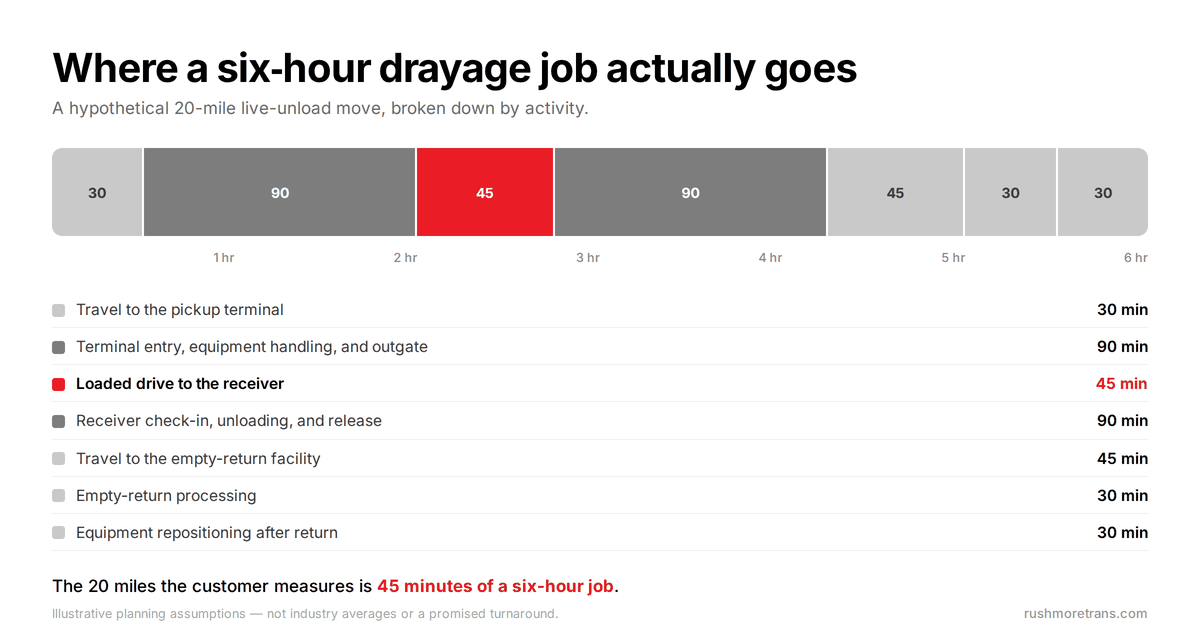
The following times are illustrative planning assumptions, not industry averages or a promised turnaround.
| Activity | Illustrative time |
|---|---|
| Travel to the pickup terminal | 30 minutes |
| Terminal entry, equipment handling, and outgate | 90 minutes |
| Drive the loaded container to the receiver | 45 minutes |
| Receiver check-in, unloading, and release | 90 minutes |
| Travel to the empty-return facility | 45 minutes |
| Empty-return processing | 30 minutes |
| Equipment repositioning after return | 30 minutes |
| Total job time | 6 hours |
Only 45 minutes in this example is the loaded drive the customer initially measured.
That does not establish what every 20-mile shipment should cost or how long it should take. It shows why the loaded distance alone cannot describe the work.
If terminal processing and unloading each improve by 30 minutes, the job saves an hour without changing the delivery distance at all.
Why a Shorter Drayage Move Can Cost More Than Expected
Mileage affects fuel, maintenance, and travel time. But a drayage truck also commits driver time, equipment, and a place in the dispatch schedule.
A short move with lengthy waiting and a separate return trip may consume more resources than a longer move with predictable pickup, fast unloading, and a straightforward equipment return.
This is why dividing a drayage quote by loaded miles can produce a misleading comparison.
Compare the included work instead:
- Pickup and delivery locations.
- Live unload or drop service.
- Included waiting time and how additional time is measured.
- Chassis provision and usage.
- Empty collection and return.
- Additional stops or equipment movements.
- Charges requiring advance approval.
A delay is not automatically a valid extra charge. Billing should follow the agreed terms and supporting records.
Clear pricing helps both sides distinguish the planned service from work added after booking.
Several Different Clocks Can Affect the Same Shipment
A short drayage move may involve several independent deadlines.
The terminal has pickup availability and free-time rules. The receiver has an appointment. The container has equipment-use terms. The chassis may have its own billing period.
Moving the container out of the terminal can stop one type of charge while other equipment charges continue.
That distinction matters when considering a pre-pull: collecting the container before its delivery appointment and holding it temporarily.
A pre-pull can help bridge the gap between terminal availability and warehouse receiving. It can also add handling, yard storage, chassis usage, and another truck movement.
Compare the complete cost and schedule before choosing it. Saving one charge is useful only when the alternative plan makes sense overall.
How Shippers Can Make Short-Haul Drayage Easier
Provide Complete Information Before Dispatch
Send the exact terminal, container number, size, weight, delivery address, receiving instructions, and known deadlines.
For Chicago-area moves, “the Chicago ramp” is not a complete pickup location. Confirm the railroad and specific facility.
Match Pickup Readiness With Receiving Capacity
Coordinate terminal availability and warehouse acceptance together.
A container ready Tuesday and a receiver available Friday need a plan for the gap. That might involve a different appointment, temporary storage, or another agreed arrangement.
Confirm How Unloading Will Work
Identify whether the cargo is palletized, floor-loaded, unusually heavy, or requires specialized handling.
Confirm live-unload expectations or, for a drop, how and when the warehouse will report that the container is empty.
Approve Contingencies Before They Become Urgent
Name the person authorized to approve additional handling, temporary storage, rescheduling, or another collection attempt.
Agree on when dispatch should escalate a problem. A useful update explains what happened, what options remain, and what decision is needed.
Record the Milestones That Explain Delays
Useful timestamps include terminal arrival and departure, receiver arrival and release, empty-ready notification, and completed return.
Over several shipments, these records can reveal whether time is being lost at pickup, receiving, or equipment return.
That gives everyone something more useful to improve than the mileage.
Common Questions About Drayage Distance
How Far Is a Typical Drayage Move?
Drayage commonly connects ports or rail terminals with warehouses, distribution centers, or other freight facilities. Many moves are local, while others extend into regional service areas. Ask the provider about the specific route rather than relying on a single mileage definition.
Why Can a 20-Mile Delivery Take Several Hours?
The loaded drive is one part of the job. Terminal processing, equipment handling, unloading, and empty return can account for much of the total time. The six-hour example above illustrates that possibility; actual results depend on the shipment.
Does a Nearby Warehouse Mean Same-Day Delivery?
Proximity helps, but same-day delivery also depends on container availability, releases, truck and chassis capacity, and the receiving appointment. Confirm those conditions before making a delivery commitment.
Is Dropping the Container Always Faster or Cheaper?
A drop can shorten the driver’s initial visit. It may also require later collection and additional equipment time. Compare the complete drop-and-collection arrangement with the expected live-unload process.
What Is the Best Way to Reduce Drayage Costs?
Start with avoidable waiting, failed pickups, incomplete instructions, and delayed empty-ready notifications. Better coordination can reduce the resources needed for a move even when the route stays exactly the same.
Plan the Complete Move With Rushmore
Rushmore Transportation LTD provides container drayage throughout Chicagoland and the Midwest.
For a quote, share the pickup terminal, delivery address, container details, cargo weight, receiving appointment, and unloading requirements. Include known pickup deadlines and empty-return instructions.
A useful transportation plan accounts for every stage needed to complete the shipment. The road may be short. The planning still deserves the full distance.
Related Guides
- How Much Does Drayage Cost? An Itemized Quote Explained
- Drayage Accessorial Charges: A Line-by-Line Guide
- How Container Drayage Works: From Arrival Notice to Empty Return
- Port Drayage vs. Rail Drayage: What Changes for the Shipper?
Need a container moved?
Topics
Recent articles
- Chicago Drayage Rates: What Information Is Needed for an Accurate Quote? September 26, 2026
- Drayage Accessorial Charges: A Line-by-Line Guide September 18, 2026
- How Much Does Drayage Cost? An Itemized Quote Explained September 18, 2026
- Drayage Distance: Why Short Haul Does Not Mean Simple September 17, 2026
- What Is an Intermodal Marketing Company? The Company Connecting Rail, Trucks, and Your Delivery September 16, 2026